

How To Seal A Granite Countertop And Keep It From Getting Stained

Granite Countertop Sealing Tips
By Troy Cantini
Granite is a natural stone that can become stained, etched or discolored over time. Granite is one of the most durable, dense and chemical resistant natural stones but it should still be sealed to protect it. Granite countertops can also absorb food and liquid contaminates allowing bacteria to grow in the stone. Sealing your granite countertop is the best way to protect it and keep in looking beautiful for years to come.

There are various opinions on the merits of sealing granite countertops. Some people believe that sealing grante countertops is a waste of time and money. Some granites are extremely dense stones so they will not absorb a sealer so sealing them is truly a waste of time and money. Black granites in particular are typically extremely dense stones that will not absorb a sealer. Many people also believe that the nature of granite being extremely chemical resistant makes in not necessary to seal granite.
The main reason to seal granite countertops is to protect them from absorbing grease and liquid spills and becoming stained. Many granites are somewhat porous and some types of grease and food products can be absorbed by the granite. It is often impossible to know exactly which types of contaminates can stain a particular granite. For this reason it is best to seal all granite to keep food based contaminates from being absorbed by the granite. Sealing the granite will allow you time to wipe away any spills on the granite before the spills are absorbed by the granite. Even when the granite is sealed you should still not allow any food or liquid contaminated to sit on the granite for a long period of time.

Sealing granite countertops with a quality impregnating sealer will not damage, discolor or alter the appearance of the granite. When granite countertops are properly sealed there will be no difference in the look, feel or level of polished sheen of the granite. You should only use a high quality sealer and pour it directly on to the countertop. The price of a high quality sealer like Aquamix Sealers Choice Gold is only a fraction of the cost of the granite countertop. It is a small price to pay to ensure your granite is properly protected. High quality sealers will also not break down or fade away over time. One quart of sealer is enough to seal most granite countertops and also the tile backsplash.
The best quality stone sealers will have the latest microbond technology. Microbond based sealers will penetrate into even the most dense stones and bond with the stone to provide the maximum protection. It is definitely not recommended to try to save a few dollars on a second rate stone sealer from a home improvement store when protecting a high priced item such as a granite countertop. Aqua mix sealers choice gold is a top of the line type of stone sealer with the newest advanced microbond technology.

After applying the sealer to the granite countertop you should spread it around with a cotton or terry towel. It is important to allow the sealer at least 5-10 minutes for the sealer to absorb into the granite. Keep the countertop saturated with sealer for 5-10 minutes. You can continually wipe the area of granite that you are sealing with the towel to ensure that the granite is thoroughly saturated with sealer. Never allow the sealer to dry on the surface of the granite countertop. Dried areas of sealer can cause a sealer haze or a sealer residue problem on the surface of the countertop.
Sealing the edges of the granite countertop is also extremely important. The edges of a granite countertop get exposed to a lot of dirt, stains and contaminates as well. You should seal the edges of the granite countertop at the same time as you are sealing the surface. It is more difficult to saturate the vertical edges of the granite countertop with sealer.
You do not want the sealer to drip down and excessively stain the floor or wood cabinets. Usually a couple of drops of sealer that are dripped down and quickly wiped away will not damage most surfaces. You should always test an area of the floor to ensure that it will not be damaged with drips or spills of sealer. If necessary plastic tarps should be used to prevent any drips or spills of sealer from landing on the delicate floors or cabinets.

After the sealer has been allowed 5-10 minutes time to soak into the granite countertop then the excess sealer must be wiped away and cleaned up. Paper towels are the best way to clean up any excess sealer from the surface of the granite countertop. Use a wad of paper towels and wipe as much of the sealer off of the granite countertops surface as possible. After the wad of paper towels becomes wet with sealer then throw it away and make another wad of paper towels and continue the procedure. Keep wiping all the excess sealer off the surface of the granite countertop until you are sure there are no traces of sealer sitting on the surface of the granite.
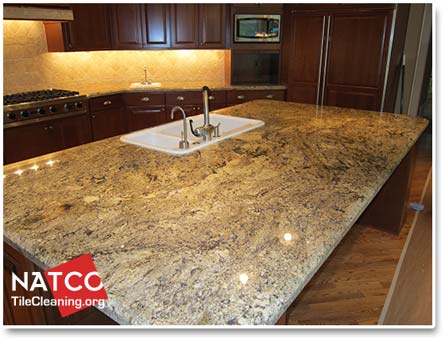
After sealing the granite countertop you should inspect the granite countertop from all angles for any evidence of sealer haze or sealer residue. Often times a sealer residue or haze will not be visible until the granite countertop is viewed at certain angles or under certain lighting conditions. It is important to clean up any sealer haze or residue problem as quickly as possible. You can apply some extra sealer over top of these areas of sealer residue to reactive the dried on sealer. Once reactivated the sealer residue can be wiped away and removed with ordinary paper towels.
After sealing your granite countertop you should wait at least 4 hours before using your granite countertops. You should only use proper stone cleaning products when cleaning your granite countertops. Incorrect cleaning products and procedures can often cause more harm than good when cleaning and maintaining your granite countertop. Aggressive cleaning products can also break down the sealers that were applied to your granite countertop. A gentle pH neutral granite countertop cleaning solution should be used for daily cleaning and maintenance of the granite.
NATCO Related Articles>
 How To Properly Seal Grout
Grout is extremely porous and needs to be sealed and re-sealed on a periodic basis.
Read more» How To Seal Saltillo Tiles
Due to Saltillo tiles being extremely porous it is best to seal them with a topical glossy sealer.
Read more» How To Seal Slate Tiles
There are various sealers and sealing options available for sealing the porous slate tiles.
Read more» Stone Sealer Reviews
Stone sealers come in many formulas and they vary in how good they protect your natural stone tiles.
Read more»